
Five Prompts That Turn AI Into Income
The Blank Screen Is Costing You Money
You have skills, a spare hour or two most evenings, and a nagging sense that other people are earning real money with the same AI tools sitting open on your laptop. So why does the cursor keep blinking at you?
The bottleneck usually isn't the tool. It's the blank screen — the twenty minutes you lose figuring out what to type before you produce anything a client would pay for. That friction is where most side hustles quietly die.
The fix is a small library of prompts you can paste, tweak, and sell the output of the same day. Not vague "write me something good" requests, but structured instructions that hand you a finished-enough draft in seconds. A skilled freelancer charges $50 to $150 for a 1,000-word blog post and $80 to $150 an hour for writing work. The prompts below let you produce that work faster, which is the whole trick to earning more per hour.
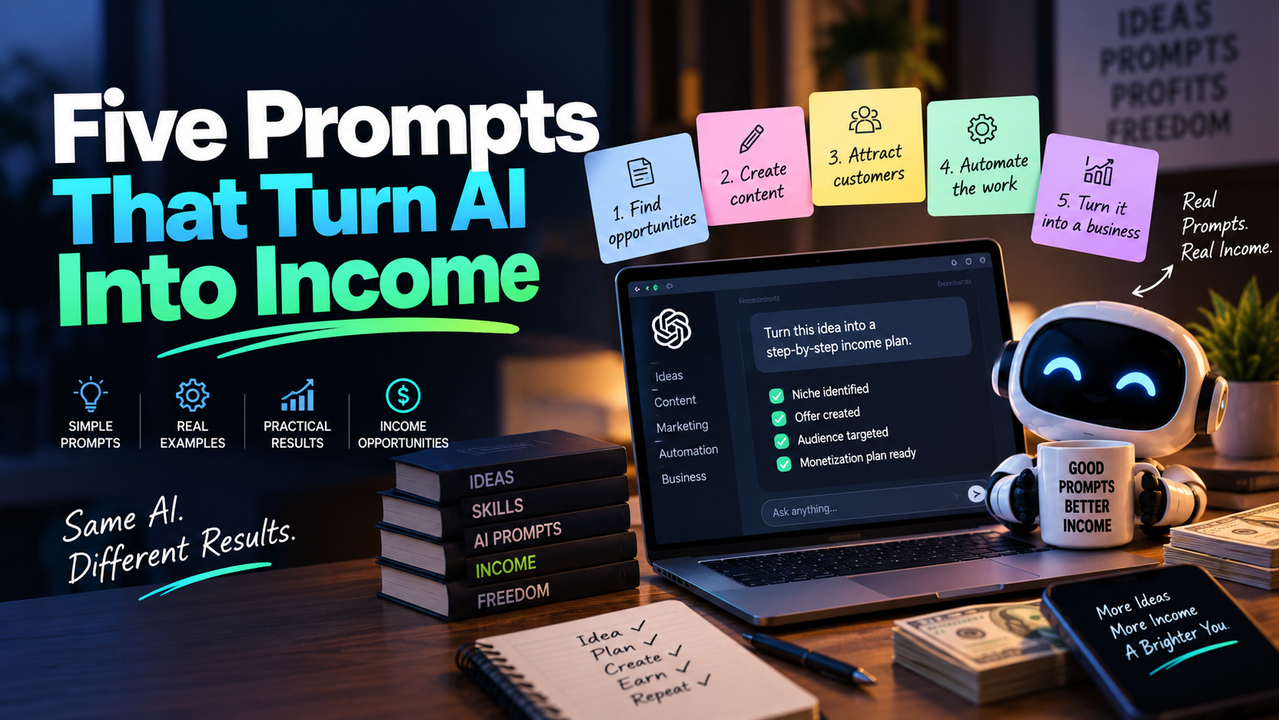
Here are five that map directly to services people are paying for right now — with the exact path from prompt to payment.
What Separates a Money-Making Prompt From a Toy
Plenty of prompts produce clever output that no one will pay for. The ones that earn share three qualities.
They target a service someone already buys. Businesses spend $300 to $2,500 a month on content and social help. A prompt that plugs into that spending has a market. A prompt that generates fantasy poetry does not.
They're specific enough to skip the rewrite. The difference between output you publish and output you delete is the context you supply: audience, format, tone, length, and a clear job to do. Loose prompts create more editing work than they save.
They produce something you can package. A one-off answer is a favor. A repeatable format — 20 product descriptions, a five-email sequence, a week of video scripts — is a product with a price tag.
Judge every prompt against those three. If it names a paying niche, needs little cleanup, and scales into a package, it belongs in your toolkit. The five that follow clear all three bars.
The Five Prompts
1. The SEO Blog Draft Engine
Serves local businesses and small SaaS companies that need a steady stream of search-friendly articles but can't afford an agency.
You are an SEO content writer for [niche] targeting [audience]. Write a
1,200-word blog post on "[topic]". Open with a hook that names the reader's
problem. Use H2 and H3 subheadings built around the questions this audience
searches. Work the phrase "[keyword]" naturally into the intro, one heading,
and the conclusion. Close with a soft call-to-action. Keep sentences short and
concrete — no filler.
How you get paid: Freelance writing gig. Offer a clear package: "SEO blog post, 1,200 words, edited, delivered in 48 hours." Entry rates run $50 to $150 per post. Deliver two a week and you're at $250 to $500 weekly while you build reviews. Most freelancers double their rates within 60 to 90 days of consistent delivery, so the same two posts a week can climb toward $600 to $1,000 as your portfolio grows. Always edit the draft — the prompt gets you 80% there, and the last 20% is what clients pay for.
2. The Product Description Batch Generator
Serves e-commerce sellers on Shopify, Etsy, and Amazon who have dozens of listings written like spec sheets.
Write conversion-focused product descriptions for an online store. For each
product I paste below, produce: a benefit-led headline, a 60-word description
that leads with the outcome the buyer wants, three scannable bullet features,
and one line handling the most common objection. Brand voice: [describe].
Products: [paste list].
How you get paid: Productized service. Single descriptions are commodity work, so sell in volume instead: a pack of 20 for $150 to $250, or 50 for $300 to $500. One store owner becomes a repeat client every time they add inventory. Pitch three local or niche Etsy shops, land one, and a single afternoon's batch covers a $200 to $400 week. Because the format is fixed, your speed — and hourly rate — rises with every order.
3. The Short-Form Video Script Pack
Serves creators and small brands that need a constant feed of Reels, TikToks, and YouTube Shorts.
Act as a short-form video scriptwriter. Give me five 30-second scripts for
[brand/niche] aimed at [audience]. For each: a scroll-stopping first line, a
three-beat body that teaches or entertains, and a closing line that prompts a
comment or save. Add an on-screen text suggestion per script. Vary the angles
so none feel repeated.
How you get paid: Per-asset or retainer. Scripting and light editing run $20 to $150 per clip depending on depth. Package four finished Reels for $800 to $1,500 — a rate small businesses already pay for short-form assets. Sell one package a week and you clear the top of that range monthly. Bundle scripting with basic editing in a free tool and you own a service most clients would rather outsource than learn.
4. The Local-Business Chatbot Flow
Serves salons, clinics, gyms, and trades that lose leads by missing messages after hours.
Design a customer-service chatbot conversation flow for a [business type].
Map the flow for three goals: answering the five most common questions,
qualifying a lead (budget, timing, service needed), and booking or routing to
a human. Write the exact bot messages, the decision branches, and the fallback
when it can't help. Keep the tone friendly and on-brand for [business].
How you get paid: Project work — the highest ceiling here. Build the flow in a no-code tool like ManyChat or Voiceflow over a weekend and deliver a working system. Freelancers charge $500 to $3,000 per chatbot build, plus an optional maintenance retainer. Land one project a month and it outpaces most content work on its own. Start by building a demo bot for a fictional business as your portfolio proof, then pitch shops in your area.
5. The Email Welcome Sequence
Serves coaches, newsletter owners, and online stores that collect signups but never follow up.
Write a five-email welcome sequence for [business] selling [offer] to
[audience]. Email 1: warm welcome + deliver the signup promise. Emails 2-3:
build trust with a story and a useful tip. Email 4: handle the top objection.
Email 5: clear offer with a deadline. Keep each under 200 words, one idea per
email, subject lines included.
How you get paid: Freelance copy plus affiliate income. Charge $300 to $800 per sequence as a standalone service. Then recommend the email platform your clients need through its affiliate or referral program — many pay recurring commissions for every signup you send. You earn once for the writing and keep earning as long as the client stays subscribed.
Quick Implementation Checklist
- Pick one prompt that matches a skill or interest you already have.
- Swap the brackets for a real niche and run it three times to see the output quality.
- Build one sample deliverable and save it as portfolio proof.
- Write a one-line offer: what you do, the result, and the turnaround.
- Price slightly below market for your first two clients to earn reviews.
- Pitch five prospects this week — local businesses and niche sellers reply fastest.
- Always edit the AI output before you deliver; polish is the paid part.
- Raise your rate after every positive review.
Copy One. Test It Today.
Reading about earning and earning are separated by one action: pasting a prompt and pressing enter.
Pick the prompt that fits you — the writer's blog engine, the seller's description pack, the creator's script kit, the builder's chatbot flow, or the marketer's email sequence. Run it in the next ten minutes. Produce one real sample. Then send one pitch before you close your laptop tonight.
The freelancers already charging these rates didn't start with clients or credentials. They started with a repeatable process and a first send. You now have the process. The first send is on you.
Try one prompt today, and reply in the comments — or reply to the newsletter — with what you made and what happened when you pitched it. I read every one, and next week I'll break down the results readers send in.