
18 Short Story Writing Prompts to Get You Unstuck Today
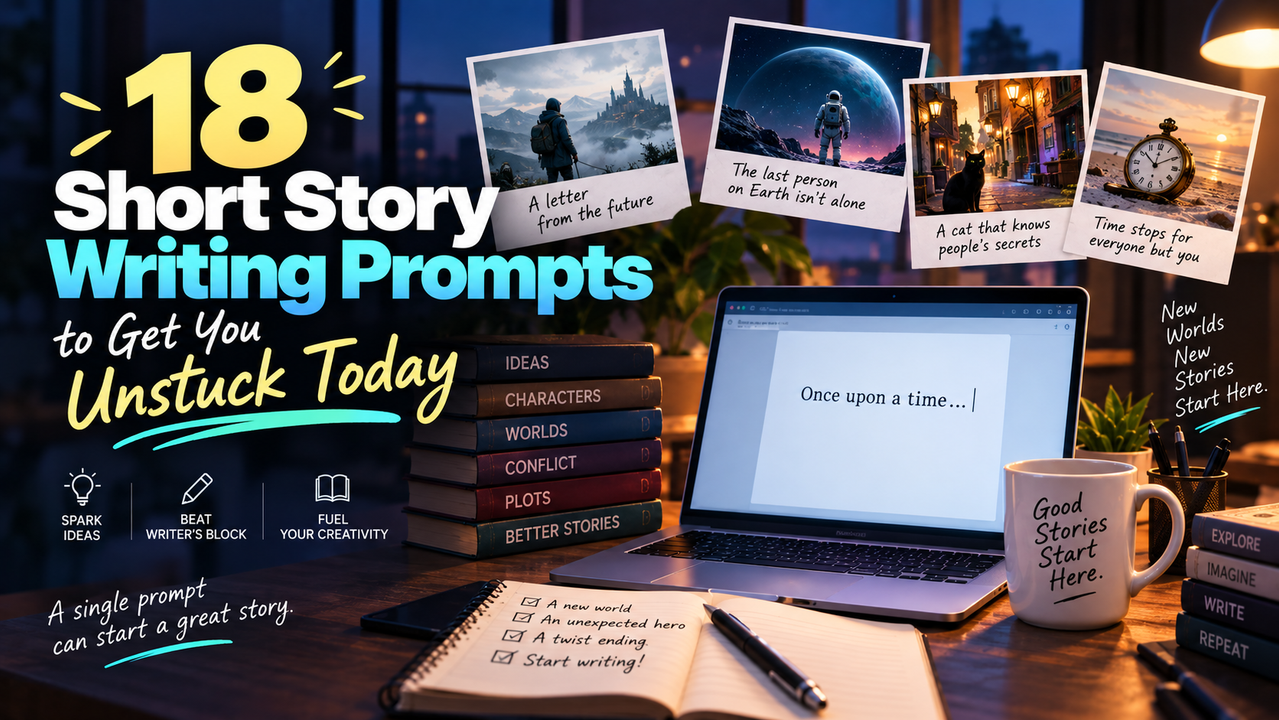
Stuck on what to write next? You open a blank document, wait for an idea to arrive, and twenty minutes later you're reorganising your bookmarks instead.
Why Prompts Work
A good prompt removes the hardest part of writing: the first decision. It hands you a character, a problem, or a place, and lets you spend your energy on the story instead of the setup. Short story writing prompts work especially well because the form is small enough to finish in one sitting, which builds the habit that longer projects depend on.
Below you'll find eighteen story starters across four categories. Pick one, set a timer, and write.
Genre-Based Prompts
Genre gives you rules, and rules give you momentum. These writing ideas each come with a built-in expectation you can honour or subvert.
- Mystery: A locksmith is called to open a safe in an empty house. Inside is a single photograph of the locksmith, taken yesterday.
- Science fiction: Every citizen receives one free memory deletion at age thirty. Your protagonist has just learned what their parents chose to erase.
- Horror: A night-shift nurse notices that the patient in room 12 has been discharged three times this week. Each time, the same patient is readmitted.
- Romance: Two rival food-truck owners are forced to share a generator during a citywide blackout. They have four hours and one working stove.
- Historical fiction: In 1912, a telegraph operator receives a message meant for someone else. Delivering it will change two lives; ignoring it will haunt hers.
Character-Driven Prompts
Plot follows people. Start with someone who wants something and cannot have it, and the story writes itself. These prompts give you the person; you decide what happens.
- A retired judge starts receiving letters from people she sentenced, all thanking her. She has no memory of being kind.
- A teenager who has never lied is asked to keep a secret that will protect his best friend and ruin his mother.
- A wedding photographer realises, mid-ceremony, that she has photographed this couple before, at a different wedding, marrying different people.
- A man who can hear other people's internal monologues meets someone whose mind is completely silent.
- The town's most reliable babysitter is caught leaving a child alone for one hour. Tell the story of that hour from her point of view.
Setting-Focused Prompts
Some of the best story ideas start with a place that refuses to behave. Let the environment create the pressure, and drop a character into it.
- A lighthouse keeper on an island where the tide has stopped coming in. It has been eleven days.
- A 24-hour laundromat where every machine runs but no customer ever enters. Your narrator works the overnight shift.
- An airport departure lounge during a fog delay. Two strangers discover they are flying to the same funeral.
- A community garden in a city that has banned growing food. Write the morning the inspectors arrive.
- A hotel corridor that is one door longer every time the housekeeper walks it.
Random Word Prompts
When you want to shake loose a fresh idea, constraint helps more than freedom. Take three unrelated words and force them into one scene. Each set below is a complete brief; use all three words in the first paragraph.
- Compass, apology, thunderstorm. A character owes an apology and keeps failing to deliver it.
- Violin, receipt, border. Something is being smuggled, and it isn't what the reader expects.
- Greenhouse, password, funeral. A family discovers what a relative was really growing.
Want more? Open any book to a random page, close your eyes, and point. The first noun you land on is your fourth word.
How to Use These Prompts
Treat short story writing prompts as a warm-up, not a test. Set a 20-minute timer and write without editing. If the prompt leads somewhere unexpected, follow it; the prompt's job is to start you, not to steer you. Keep a running file of finished drafts and revisit the strongest one each week. Teachers can assign one category per class and compare how different students interpret the same starting point.
A few extra tips that keep the habit alive:
- Rotate categories. Genre prompts one day, character prompts the next. Variety prevents the ruts that make writing feel like homework.
- Change one element. If a prompt doesn't spark, swap the setting or the character's age and try again. Most story starters have three good stories hiding in them.
- Finish something. A rough 600-word ending beats a polished 200-word opening. Completion is the skill you're building.
- Share early. Read a draft aloud to one person within 48 hours. Feedback while the story is fresh is worth more than feedback in a month.
Why This Matters
Writers who use prompts regularly don't need them forever. After a few weeks, your brain starts generating openings on its own, because you've trained it to see a stalled tide or a silent mind as the beginning of something. The prompts are scaffolding. Once the structure stands, you take them down.
For teachers, short story writing prompts solve a different problem: they give every student the same launch point, which makes discussion richer and grading fairer. When ten students write the lighthouse story, you learn ten things about how they think.
Your Turn
Pick one prompt from this list, write for twenty minutes, and post your opening paragraph in the comments. Want a fresh set of short story writing prompts every Monday? Join the newsletter and we'll send them straight to your inbox.